
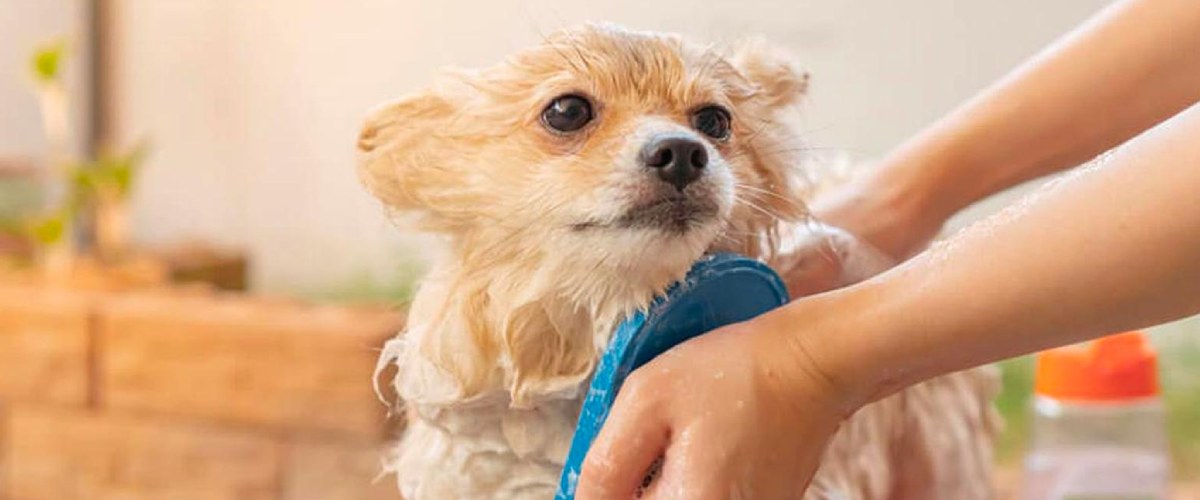
Your dog gets a bath. Two days later the scratching is back. The coat that looked clean now feels dry, and the skin under the collar is pink and tight. Sound familiar?
Most pet parents we meet at Pets in the City are doing everything by the book. Regular baths, a reasonable shampoo, a proper dry afterwards. And still the same problems keep returning. The usual suspect is the shampoo, and sometimes that's right. But in Dubai, the fuller answer often starts somewhere most people never think to look: the water coming out of the tap.
- Dubai's tap water is desalinated, then remineralised by DEWA to a moderately-hard 100–250 mg/L (calcium carbonate). Building tanks can push it higher.
- Hard water leaves more shampoo residue on the skin. A 2018 clinical study found hard-water washing significantly increased surfactant deposits and skin irritation (Danby et al., J Invest Dermatol).
- Most recurring post-bath itching clears up by rinsing longer, using a mild fragrance-light shampoo, always conditioning, and drying fully, not by switching to a stronger product.
Is Dubai's tap water actually hard?
Yes, but not the way you might expect. Dubai's tap water begins as desalinated seawater, which is almost mineral-free after reverse osmosis. DEWA then adds calcium and magnesium back in to stabilise it, landing at roughly 100 to 250 mg/L as calcium carbonate, which sits in the moderately-hard to hard range (Dubai water report; DEWA standards). Storage tanks and ageing building pipes can lift that figure further before the water ever reaches your pet's bath.
So this isn't naturally hard groundwater like you'd find in London or much of the US. It's engineered to a moderate hardness on purpose. The mineral load is gentler than a limestone region, but it's more than enough to change how shampoo behaves on a sensitive coat. That's the part that matters for grooming.
What hard water does to your pet's skin and coat
When shampoo meets calcium and magnesium, the surfactants that do the cleaning bind to those minerals and stop rinsing away cleanly. They settle onto the skin as a fine film. In a 2018 King's College London and University of Sheffield study, skin washed in hard water held significantly more surfactant residue and lost more moisture than skin washed in softened water, and the irritation was worst where the skin barrier was already weak (Danby et al., J Invest Dermatol, 2018). A 2021 review of the evidence reached the same conclusion.
Pets are more exposed to this than we are. Their skin is thinner, sits at a different pH, and many breeds carry dense coats that trap both residue and moisture long after the bath is over. We should be honest that direct research on dogs is still thin, but vets expect the same mechanism to apply, and it lines up with what we see on the van every week (Dogster, vet-verified). The tell is a coat that feels almost clean but not quite, or skin that turns tight and dry by the time the pet is fully dry.
If your dog already battles flaky or reactive skin, hard-water residue stacks on top of whatever else is going on. Our guides to the gut-skin connection behind flaky skin and common pet skin issues in the UAE dig into those underlying triggers.
Why Dubai makes sensitive skin worse
Sensitive skin in the UAE rarely has a single cause. It's usually a slow pile-up of pressures hitting at once. The heat ramps up oil production. Fine sand and dust work their way into the coat, around the paws, and along the belly. Indoor air conditioning dries the skin from inside the home, while outdoor humidity slows how fast the coat dries after a wash.
And because the heat makes pets feel and smell dirty sooner, owners quite reasonably start bathing more often. If the products aren't right, that extra washing makes the underlying problem worse, not better. It's why the same dog can be perfectly comfortable in January and scratching constantly by May. The environment shifted, the bathing schedule shifted with it, and the skin barrier simply couldn't keep up. Summer beach trips add salt and sun on top, as we cover in our Dubai dog-beach skin-care guide.
The post-bath itch pattern to watch for
There's a fairly predictable sequence when a shampoo isn't rinsing well in Dubai's conditions. Dryness or flaking shows up right after drying. Itching peaks around day two to four. The coat then goes dull or greasy ahead of schedule, and redness creeps into the warm spots: armpits, groin, and the collar line.
If that pattern repeats after every single bath, the instinct is to reach for something stronger or more clarifying. That instinct is almost always wrong. Heavy degreasers and high-foam formulas are exactly the products that struggle most to rinse cleanly out of a coat in hard water. They strip more than they clean, and the skin reacts accordingly.
How to wash your pet safely in hard water
Here's the encouraging part. Most recurring irritation isn't cured by a miracle product. It's fixed by tightening up the basics. Run through this checklist before you change anything else:
- Rinse far longer than feels necessary — twice as long as you think, with extra attention under the collar, in the armpits and groin, and through any dense fur. Incomplete rinsing is the single most common thing we see.
- Choose a mild, fragrance-light shampoo — made for sensitive skin. Skip heavy degreasers and high-foam formulas that cling to hard-water minerals.
- Always use a conditioner — then rinse that out fully too. It smooths the cuticle, helps residue lift away, and protects the skin between washes. Even short-coated dogs benefit.
- Dry completely before bedtime — damp fur sitting in Dubai's humidity overnight is an irritant all on its own.
- Stretch baths to every two to four weeks — unless your vet advises otherwise. Frequency isn't the enemy; the wrong products plus poor rinsing is.
- Test or filter your water if itching persists — a cheap home hardness test, or a simple shower filter, can confirm whether minerals are part of the picture.
Diet plays a supporting role too. The right nutrients help the skin barrier recover faster between baths, which we break down in our piece on zinc and omega-3s for a healthy coat.
Three washing habits that quietly backfire
1. Routine whitening shampoos
This comes up constantly with white and cream-coated dogs. A whitening shampoo keeps the coat looking bright, right up until it doesn't. These formulas lean on stronger cleansing agents to lift stains fast, and in hard water they tend to strip the coat instead of cleaning it. The fur looks crisp but feels rough, and the skin underneath ends up drier than before. Used occasionally on a dog without sensitivity, they're fine. As a weekly wash for an already-reactive coat, they're one of the more common triggers we see.
2. Going stronger when the itch appears
A clarifying or degreasing shampoo feels like the logical fix for a greasy, itchy coat. In hard water it's usually the worst rinser of the lot, so more residue stays behind, not less.
3. Treating conditioner as optional
Conditioner gets written off as a luxury for long-haired breeds. In Dubai it's genuinely one of the more useful tools for managing sensitive skin. Skip it and day one feels fine, by day three the skin is tight, and by day five the scratching is back.
When to bring in a professional
If the irritation sticks around after you've tightened the basics, see your vet first to rule out allergies, parasites, or infection. Hard water makes things worse, but it's rarely the whole story on its own, and it's worth checking the bigger picture covered in our guide to the top pet health issues in Dubai.
For the wash itself, a good groomer controls the two things that matter most here: product choice and rinse time. With mobile grooming especially, getting those right at every appointment tends to solve what looks like a chronic skin problem, without any dramatic intervention. You can read how we keep that process calm and consistent in our mobile grooming safety checklist.
Book a Stress-Free Mobile Grooming Visit →
Frequently asked questions
Is Dubai tap water hard or soft?
It's moderately hard. Although it starts as near mineral-free desalinated seawater, DEWA remineralises it to roughly 100 to 250 mg/L as calcium carbonate, and building storage tanks can raise that further.
Can hard water really make my dog itch?
It can. Hard-water minerals leave more shampoo residue on the skin, which disrupts the skin barrier and increases moisture loss and irritation, an effect confirmed in human clinical studies and expected to apply to pets.
How often should I bathe my dog in Dubai?
Every two to four weeks suits most dogs and cats unless your vet recommends otherwise. The frequency matters far less than using the right product and rinsing thoroughly.
Do I need a water softener for my pet?
Not usually. Most irritation clears up by adjusting technique first: longer rinsing, a mild shampoo, and conditioning. If problems persist, a shower filter or softener can help confirm and reduce the mineral load.
What shampoo is best for sensitive skin in hard water?
A mild, fragrance-light shampoo formulated for sensitive skin, paired with a conditioner. Avoid heavy degreasers, high-foam formulas, and routine whitening shampoos, which rinse poorly in hard water.
