
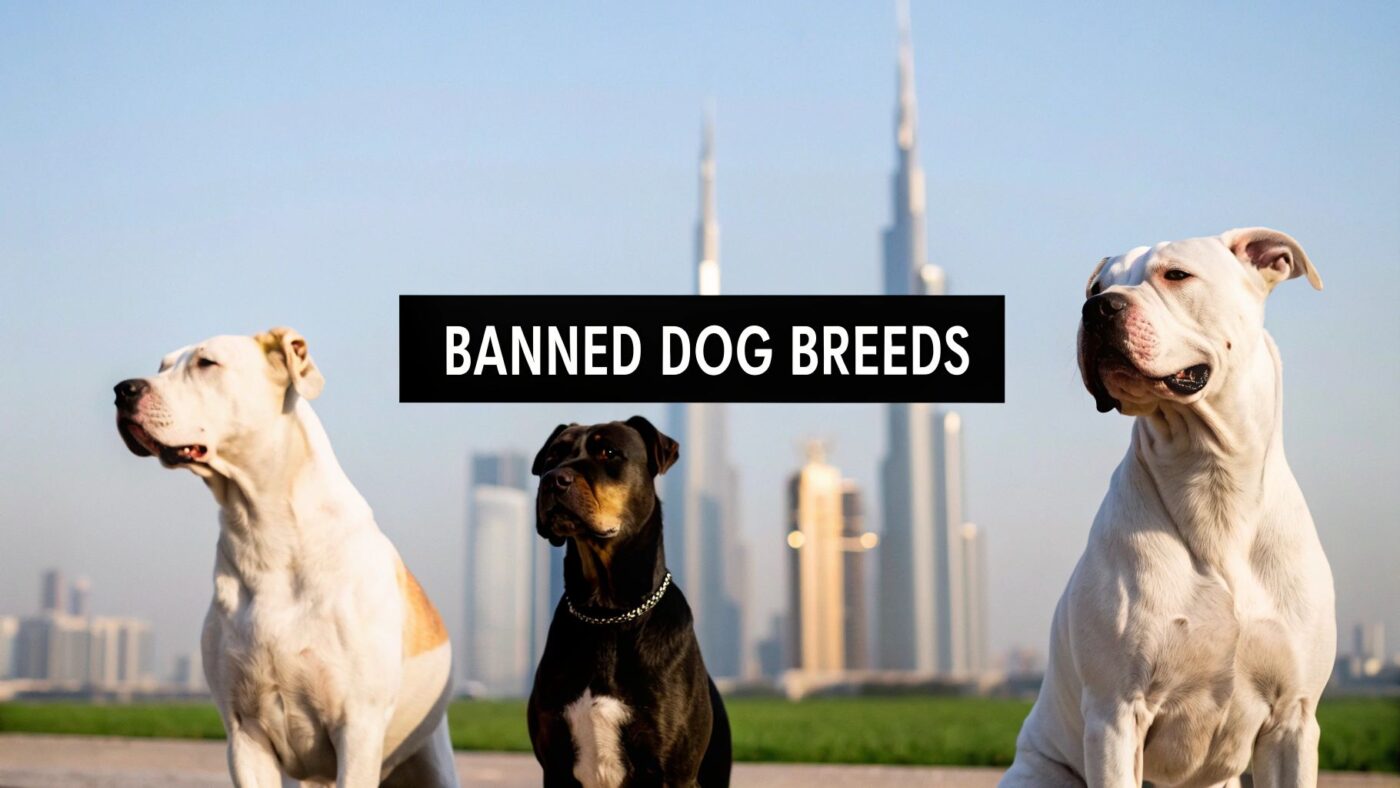
Bringing a dog into Dubai, or adopting one once you’re here, starts with one question that matters more than any other: is your breed allowed? Get this wrong and the consequences are real, from heavy fines to a pet being refused at the airport. So before you think about permits or paperwork, you need to know where your dog stands under UAE law.
Some breeds, including Pit Bulls and several Mastiff types, are completely banned. They can’t be owned, bred, or imported into the country. Others sit in a restricted category that allows ownership with extra conditions. The framework is set by Federal Law No. 22 of 2016 and overseen by the Ministry of Climate Change and Environment (MOCCAE), and it’s still the law of the land as of June 2026 (U.AE, updated June 2026).
Last reviewed: June 2026. Rules current under Federal Law No. 22 of 2016 and Cabinet Decision No. 15 of 2019.
Key Takeaways
- Owning, breeding, or importing a banned “dangerous” animal carries fines from AED 10,000 to AED 700,000 (U.AE, 2026).
- Walking any dog off-leash in public can cost AED 10,000 to AED 100,000 (The National).
- Banned breeds are refused at the border, paperwork and vaccinations don’t override the ban, and a mixed-breed dog can be flagged on looks alone.
- Every dog in Dubai must be microchipped, registered, leashed in public, and many restricted breeds must be muzzled too.
Which Dog Breeds Are Banned or Restricted in Dubai?
Two tiers govern dog ownership here. Fully banned breeds, mostly Pit Bull types and large Mastiffs, can’t be owned or imported at all. Restricted breeds can be kept with a permit, registration, and strict leash-and-muzzle rules. Both tiers flow from Federal Law No. 22 of 2016 on dangerous animals (Gulf News).

The list is owned by the Ministry of Climate Change and Environment (MOCCAE), which works alongside Dubai Municipality to enforce it. The goal is simple: keep powerful, high-risk breeds out of everyday public spaces and make sure the dogs that are allowed are handled responsibly.
Why Do These Rules Exist?
The thinking behind the law is risk management, not labelling individual dogs as “bad.” The UAE flags breeds based on their history (fighting or guarding lines), their physical power, and the seriousness of injury they could cause. The aim is to cut the number of severe dog-bite incidents in a busy, family-heavy city.
It helps to see it this way: the law targets categories of risk, not the temperament of your particular pet. That’s also why compliance is taken so seriously. Penalties are steep, and “I didn’t know” carries no weight with an inspector or a court.
Official Banned & Restricted Dog Breeds in Dubai (2026)
So, could your dog be on the list? The table below sets out the breeds most commonly reported as banned or restricted under MOCCAE’s framework. Check it carefully before you import a dog or adopt one locally, because the cost of guessing is high.
A quick heads-up: MOCCAE can update this list at any time, and the exact make-up of the “restricted” tier varies between sources. Always confirm your specific breed directly with Dubai Municipality or MOCCAE before making any decision for your family and your pet.
| Breed | Classification | Notes |
|---|---|---|
| Pit Bull group (American Pit Bull Terrier, American Staffordshire Terrier, Staffordshire Bull Terrier) | Banned | Stocky, muscular build, broad head, strong jaw. The most commonly flagged group at the border. |
| American Bully (including XL Bully) | Banned | Prohibited from import and ownership. The UAE’s ban predates and is separate from the UK’s 2024 XL Bully ban. |
| Dogo Argentino (Argentinian Mastiff) | Banned | Large, powerful, white-coated hunting dog. |
| Fila Brasileiro (Brazilian Mastiff) | Banned | Heavy guarding breed bred for tracking and holding. |
| Japanese Tosa (Tosa Inu) | Banned | Large fighting breed with a short coat and muscular neck. |
| Perro de Presa Canario | Banned | Powerful guard dog with a broad, massive head. |
| Other Mastiff types (Cane Corso, Neapolitan, Bullmastiff, Boerboel, Bully Kutta, Dogue de Bordeaux, Tibetan Mastiff) | Banned / import-prohibited | Reported on MOCCAE’s import-prohibited list. Confirm the specific breed before any import attempt. |
| Wolf-dog hybrids | Banned | Any wolf cross is treated as a prohibited dangerous animal. |
| Rottweiler | Restricted | Permit, registration, leash and muzzle required. Often refused at import, so verify with MOCCAE first. |
| Doberman Pinscher | Restricted | Permit and strict public-handling rules apply. |
| Boxer | Restricted | Permit and registration required. |
| German Shepherd, Belgian Malinois, Bull Terrier | Restricted (commonly) | Frequently listed as restricted with leash/muzzle conditions. Confirm with Dubai Municipality. |
For breeds on the restricted side, ownership isn’t off the table, it just comes with extra steps: a permit, proper registration, and stricter rules for housing, leashing, and muzzling. Sources broadly agree on the banned tier (Fetchway, 2025), but they differ on the edges of the restricted tier, which is exactly why you should verify your own breed with the authorities.
What Do Dubai’s Dog Laws Actually Require?
At the centre of it all sits Federal Law No. 22 of 2016, which regulates the possession of dangerous animals, backed by its executive regulation, Cabinet Decision No. 15 of 2019 (Gulf News). Together they ban private ownership of dangerous animals and set the licensing and handling rules every dog owner must follow.
MOCCAE then issues circulars to keep the breed lists current. Think of the federal law as the foundation and the circulars as the running updates. Dubai Municipality layers its own registration and dog-walking rules on top for residents of the emirate.
What the Law Requires From You
Strip away the legal language and the duties come down to a handful of clear rules. Get these right and you’re on solid ground, whether you live in Jumeirah, Dubai Marina, or Mirdif.
- Leash at all times: Every dog must be on a leash in public spaces, with no exceptions. Restricted breeds must also be muzzled.
- Registration and microchip: Your dog must be microchipped and registered with Dubai Municipality. An unregistered pet is treated as unlicensed.
- Breeding ban: It’s illegal to breed any banned breed inside the UAE.
- Border control: Try to import a banned breed and the dog is refused entry. You pay to return it to its country of origin.
- Designated areas only: Dogs generally aren’t allowed in standard public parks or on public transport. Use designated dog parks and dog runs instead.
The point of Federal Law No. 22 isn’t to punish dogs. It’s to build a culture of responsible ownership, where every owner knows the rules and follows them, and the whole community is safer for it.
What Are the Penalties for Breaking the Rules?
The fines are large and the enforcement is real. Owning, importing, or breeding a banned dangerous animal can cost between AED 10,000 and AED 700,000 (U.AE, 2026). On top of the money, authorities can confiscate the animal, and for serious cases there’s the risk of further legal action.
Here’s how the main penalties break down:
| Offence | Fine (AED) |
|---|---|
| Owning, importing, or breeding a banned animal | 10,000 – 700,000 |
| Walking a dog off-leash in public | 10,000 – 100,000 |
| Using an animal to frighten or attack a person | 10,000 – 400,000 |
| Causing minor injury through an animal | up to 10,000 (plus possible jail) |
Figures for the leash, attack, and injury penalties are reported by The National. For more on the city’s day-to-day pet rules, our guide to navigating Dubai Municipality’s pet laws is worth a read.
The “Mixed-Breed” Grey Area
This is where it gets stressful for caring owners. Your rescue’s paperwork might say “Labrador Mix” or “Shepherd Cross,” but that label may not save you if your dog looks like a banned breed.
Officials at points of entry have the final say, and they often decide on a visual inspection. If your dog has the broad head, stocky frame, or muscular build of a Pit Bull type, it can be flagged regardless of its documents. That’s a serious risk for anyone planning a move, and the call rests with the inspector on duty, not the paperwork.
What Should You Know Before Relocating to Dubai With Your Dog?
Importing a dog into the UAE runs through MOCCAE. You’ll need an official import permit, a government-endorsed health certificate, proof of vaccination, and a microchip, and there’s a cap of two companion animals per person per year (MOCCAE). Banned breeds, though, are refused outright.
The process involves several vet appointments, plenty of paperwork, and a final inspection at the airport. Knowing the hurdles up front is what turns a stressful gamble into a smooth, planned move for your pet.
The Moment of Truth at the Border
Picture it: after months of planning and a long flight, you land in Dubai. During the visual check, an official pauses at your dog. The paperwork says “Shepherd Mix,” but the inspector sees a broad head and a stocky build, the kind associated with a Pit Bull type.
In that moment, the whole plan can stall. This isn’t hypothetical, it’s a genuine risk, and the decision often hinges on the official’s visual read rather than the documents in your hand. If your dog is denied entry, the costs land fast and hard:
- Quarantine fees: Your dog is held in a government facility while daily charges build up.
- Emergency repatriation flights: Booking a last-minute international flight for an animal is complex and expensive.
- Extra veterinary clearances: Another round of health checks and documents just to send your dog home.
One refusal at the counter can turn into a fast, costly legal review. That’s why the breed question has to be settled before you ever book a flight.
How to Make an Informed Decision
The single best protection is preparation. Arm yourself with clear, official documentation that names your dog’s breed or mix and, ideally, states that it doesn’t share characteristics with any banned breed. That paperwork is your first line of defence if your dog’s looks raise a question.
Get detailed paperwork from your vet that explicitly names your dog’s breed or heritage. For a mixed breed, the documentation should describe its primary lineage and confirm it isn’t a banned type. Vague labels invite scrutiny, specific records reduce it.
A full set of health records is non-negotiable for the import itself. Our complete veterinary checklist for relocating your pet to Dubai walks through every vaccination and health check you’ll need. And be honest with yourself about how your dog looks. If there’s real ambiguity, the risk of refusal is genuine, so make the careful call before you commit to the move.
You Already Own a Restricted Breed: What Now?
Realising your dog might sit on a restricted, or even banned, list is a gut-punch. Take a breath. The worst move is to panic or to hope it quietly resolves itself. Your first step is to contact the authorities directly, either Dubai Municipality’s Veterinary Services Section or MOCCAE, because only they can give a definitive answer for your specific dog and clarify exactly where you stand legally.
The Non-Negotiables for Every Dog Owner
Before any breed-specific question, there’s a baseline that applies to every dog in Dubai. These are the foundations of legal, responsible ownership here.
- Microchipping: A permanent ID chip is mandatory and the first thing officials check.
- Vaccinations: All mandatory shots, especially rabies, must be current, with records kept accessible.
- Municipality registration: Every dog must be registered with Dubai Municipality, which formally links the pet to you.
Microchipping and annual registration are required for a small fee. For the exact current rates, check the Dubai Municipality e-services portal, since fees are updated from time to time.
Being a Good Ambassador for Your Breed
Own a powerful breed and you carry an extra layer of responsibility. It’s not just about ticking legal boxes, it’s about making sure your dog is a calm, safe neighbour, whether you’re in Jumeirah, Dubai Marina, or Mirdif. How your dog behaves in public, and how the community sees it, genuinely shapes the conversation around these laws.
- Invest in training: Obedience classes with a certified trainer are one of the best things you can do. A dog that reliably listens, especially around people and other animals, is a safer dog.
- Always leash and muzzle: A strong, secure leash is mandatory in public, and a muzzle is a legal requirement for restricted breeds. It’s a safety measure that also reassures everyone around you.
A well-cared-for, well-behaved dog quietly improves the reputation of its whole breed. Good manners, a healthy coat, and a calm temperament can change how people, and officials, perceive your dog.
Appearance plays into this too. A clean, well-groomed dog reads as healthy and cared for, and that impression matters when you own a breed that draws extra attention. Regular grooming is also essential for your dog’s comfort in Dubai’s heat. Our at-home dog grooming service brings experienced groomers to your door, so your dog stays comfortable and looks its best without the stress of a salon trip. If animal welfare is close to your heart, you’ll enjoy reading about Dubai’s pet rescue heroes and the work they do.
Which Dogs Thrive in Dubai?
The banned list can feel discouraging at first, but it rules out only a small handful of breeds. Dubai is home to thousands of happy, healthy dogs of every shape and size, so there’s almost certainly a great match for your home and lifestyle.

Whether you’re in a Downtown apartment or a villa in Arabian Ranches, there’s a breed that fits. Here are a few that consistently do well in the UAE.
Popular Breeds That Do Well Here
- Golden Retriever: Gentle, smart, and friendly, Goldens are superb family dogs and patient with kids. Be ready for regular brushing to keep that coat healthy.
- Poodle (Miniature & Toy): Highly intelligent and low-shedding, a real plus for apartment living in areas like Dubai Marina. Their curly coats need a steady grooming routine to avoid matting.
- Beagle: Curious and cheerful, with a compact size that suits most homes. Their clever minds need toys and training to stay busy.
- Cavalier King Charles Spaniel: The classic lap dog, affectionate and perfectly happy in an apartment as long as it’s near its people.
Want more flat-friendly ideas? See our guide to great indoor pet breeds for Dubai residents.
Caring for Your Dog’s Coat in Dubai’s Climate
Whatever breed you choose, coat care isn’t optional in this climate. It’s not about looks, it’s about health: regular grooming helps prevent skin problems and keeps your dog cool through the long summer.
A well-maintained coat is a core part of your dog’s well-being. Professional grooming lets the skin breathe and helps you catch potential health issues early.
Life in Dubai is busy, and fitting in grooming appointments isn’t always easy. That’s where our mobile dog grooming comes in. We bring the tools and the expertise to your doorstep, so your dog gets a calm, stress-free session at home with undivided attention.
FAQ: Dubai’s Dog Laws Answered
The rules around banned and restricted breeds throw up a lot of specific questions. Here are clear answers to the ones we hear most from worried owners across Dubai.
Which dog breeds are banned in Dubai in 2026?
The fully banned breeds include the Pit Bull group, the American Bully and XL Bully, the Dogo Argentino, Fila Brasileiro, Japanese Tosa, Perro de Presa Canario, large Mastiff types, and wolf-dog hybrids. They can’t be owned, bred, or imported under Federal Law No. 22 of 2016 (Gulf News).
What’s the fine for not keeping my dog on a leash?
Walking a dog off-leash in a public space can bring a fine of AED 10,000 to AED 100,000 (The National). Every dog must be leashed in public, with no breed exceptions, and restricted breeds must be muzzled too. It’s one of the most strictly enforced rules in the city.
My dog is a mix but looks like a Pit Bull. What should I do?
Get solid veterinary documentation that clearly states your dog’s known lineage. Be aware that officials can still decide on a visual assessment, so paperwork isn’t a guarantee if the resemblance is strong. The safest move is to contact Dubai Municipality’s Veterinary Services Section for an official consultation before you travel or adopt.
I’m transiting through Dubai airport with my dog. Do these rules apply?
Yes. The moment your dog enters UAE territory, even in transit, the banned-breed rules apply in full. Before booking any flight routed through Dubai, confirm your dog’s breed isn’t banned, secure the correct transit permits from MOCCAE, and have all health certificates ready, or your pet could be detained at your cost.
What happens if a banned dog is seen in a public park?
Banned breeds are prohibited in public spaces, full stop. If one is found in a park, authorities can confiscate the animal immediately and impose significant fines. This is why every dog, whatever its breed, must be leashed in public, and why banned breeds shouldn’t be in these areas at all.
Are there exceptions for bringing a banned breed into Dubai?
For the average pet owner, almost never. Exemptions are rare and generally reserved for specialised working animals, such as official K9 police units or certified service animals, which go through a strict pre-approval process. If you’re relocating with a family pet, an exemption isn’t a realistic path.
Staying on top of these rules is a core part of being a responsible dog owner in Dubai, and so is looking after your pet’s health and comfort. For professional, stress-free grooming that comes to you, our team offers expert at-home dog and cat grooming across the city. Book our mobile service today.
Sources
- UAE Government Portal (u.ae): Banning private ownership of dangerous animals (updated June 2026)
- UAE Legislation Portal: Federal Law No. 22 of 2016
- MOCCAE: Import permit for pets
- The National: Law bans owning, trading and breeding dangerous animals
- Gulf News: UAE’s list of banned dog breeds
- Gulf News: Cabinet Decision No. 15 of 2019 on dangerous animals

Curated by Diya Sampat
